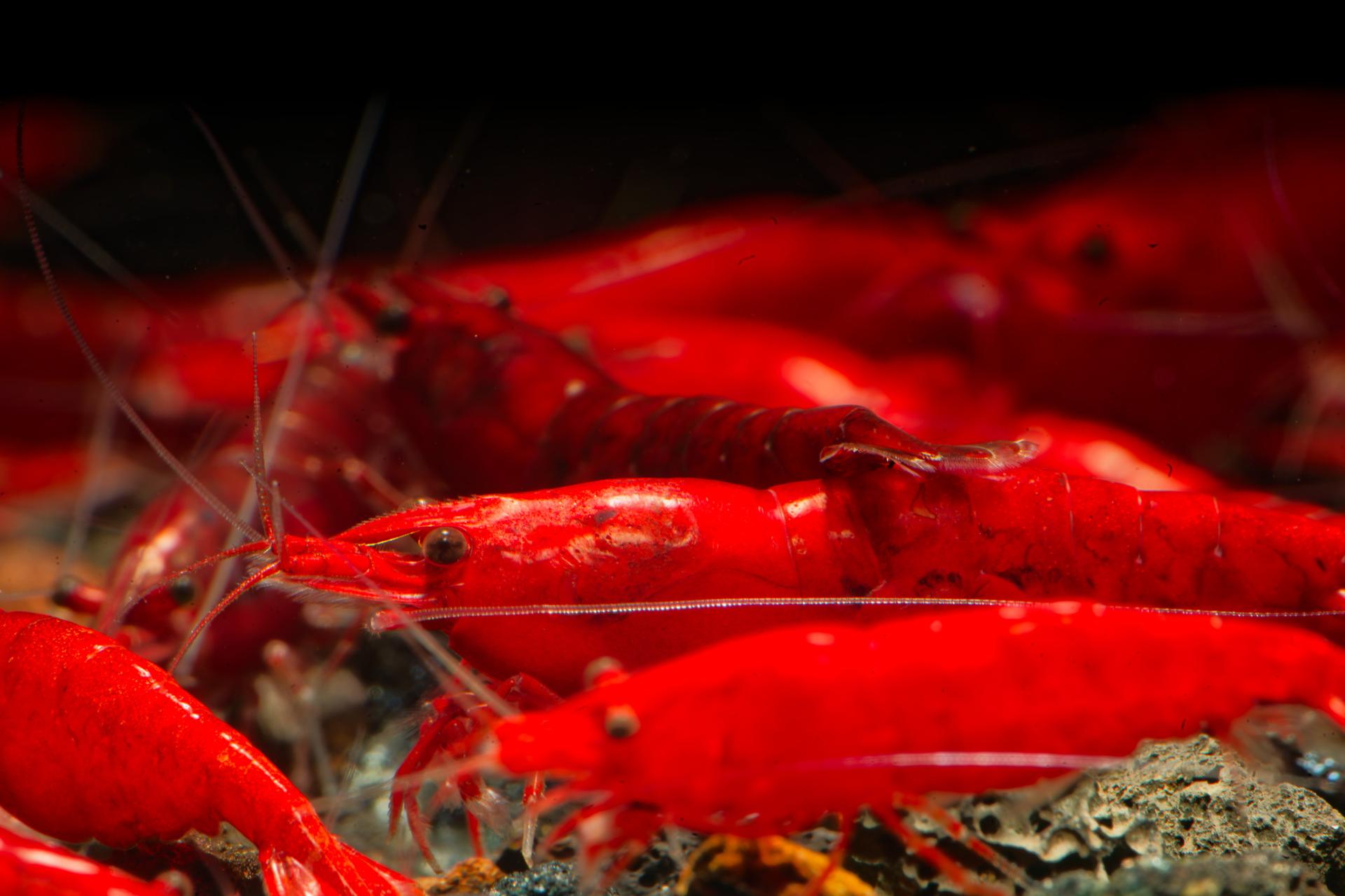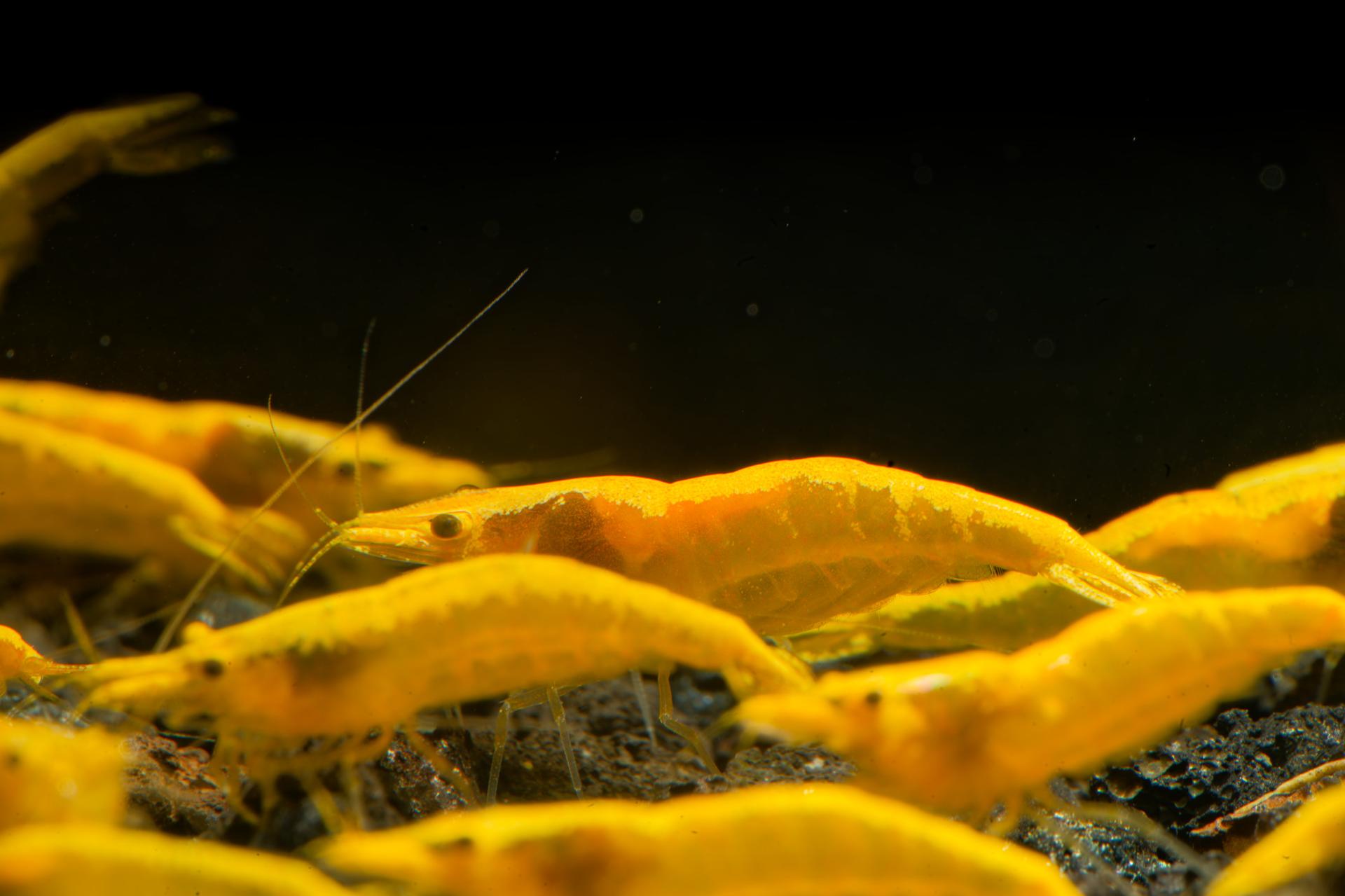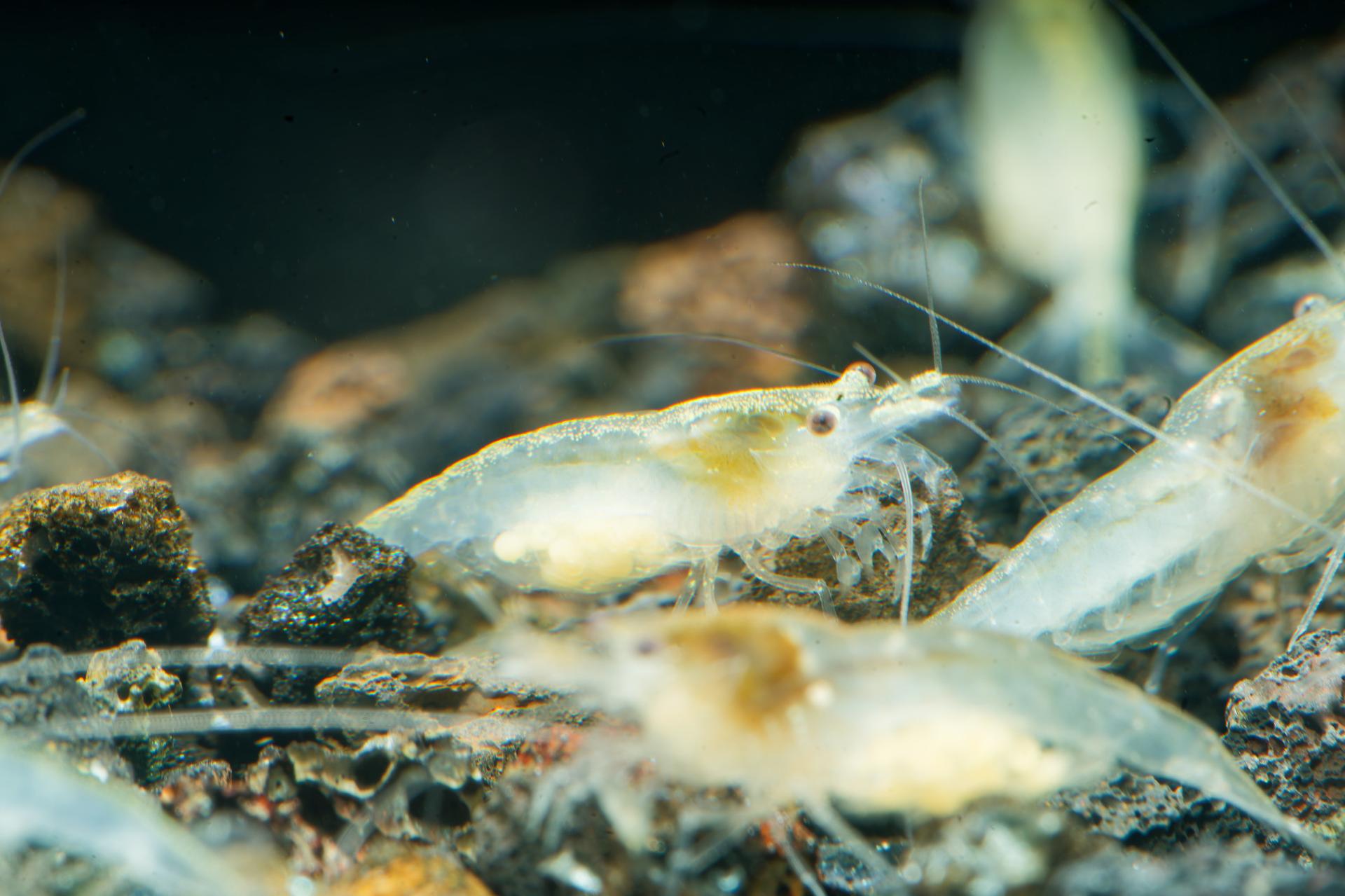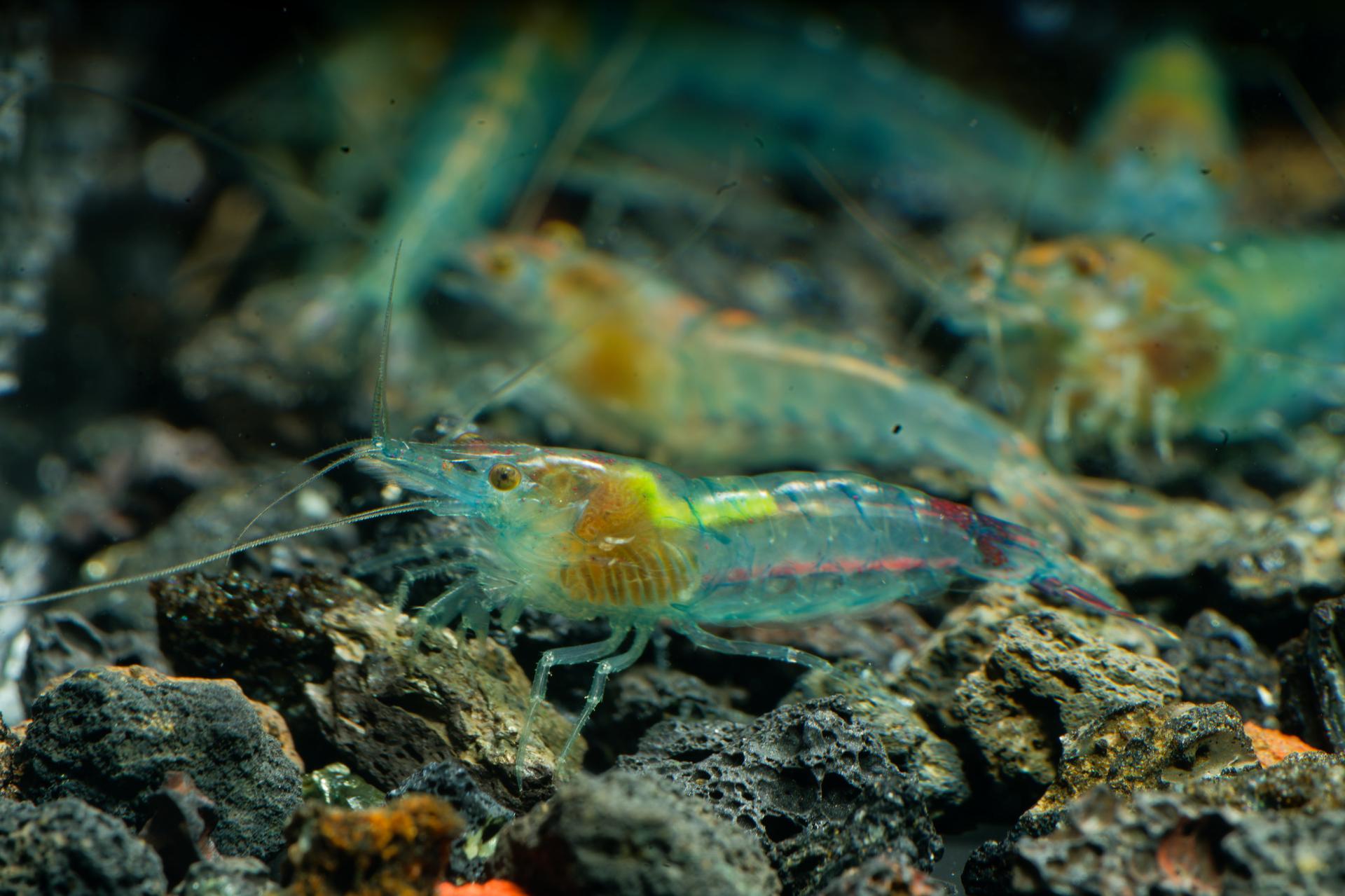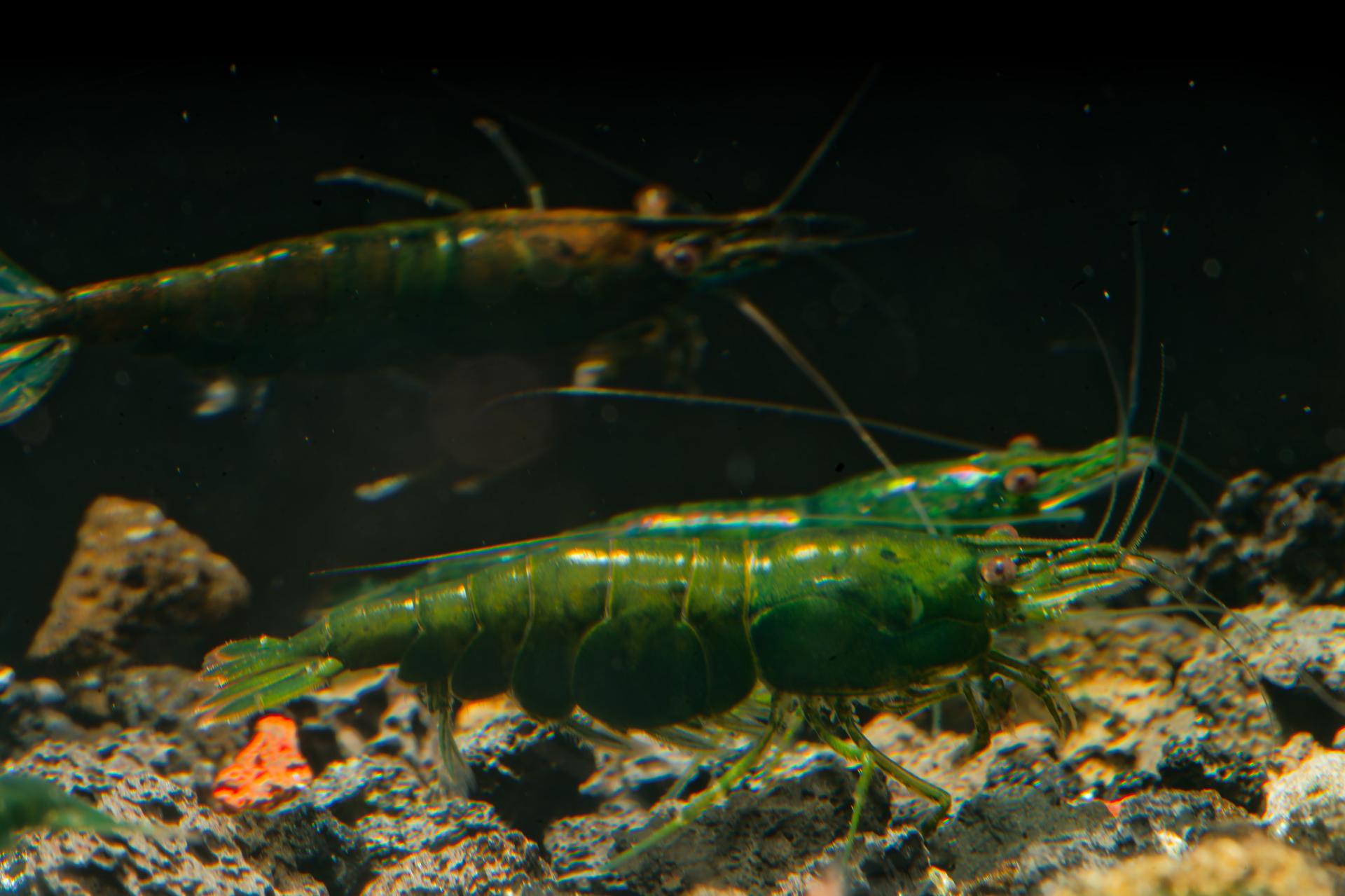
Neos Green Diamond
Green in Neocaridina is not a pigment of its own: it is blue pigment plus yellow pigment in the same animal. Being a combination is exactly why it is the least colour-stable mainstream strain — buy it expecting a spread from olive to jade, not a uniformly coloured tank.
One colour per tank. That is the entire secret to keeping a colour colony beautiful for years.
Green is a combination, not its own pigment
There is no dedicated green pigment in Neocaridina: the green is blue pigment and yellow pigment combined in the same animal. That is precisely why it is the least colour-stable of the mainstream strains. Its origin is disputed — one source describes it as a morph out of the blue lines, another says it appears spontaneously out of yellow, orange or blue lines. 'Green Diamond' and 'Green Jade' are two trade names for the same green N. davidi morph, with Green Diamond usually marketing the deeper end; no source draws a biological distinction.
Identifying and grading the green line
Ideal keeping conditions
This is the real-world band, not a figure copied from a temperate-climate care sheet. Inside it there is a sweeter spot if you want to dial things in: pH 7.0–7.5, GH 6–8, TDS 180–220, KH 3–5. But a tank sitting at GH 4 keeps and breeds them perfectly well — below 4 is where failed moults start. GH supplies the calcium and magnesium for moulting: too little and you get the 'white ring of death', where a shrimp cannot finish its moult. KH stops the pH falling. And stability still beats perfection — a colony held steady at GH 5 outperforms one chased up and down around GH 8.
Use an INERT substrate — gravel, sand or an inert shrimp gravel. Never use the active buffering soil sold for Bee/Taiwan Bee shrimp. Active soil pulls pH and KH below what Neocaridina need, and it is the most common set-up mistake beginners make.
Keeping them at tropical room temperature is CORRECT — no chiller, and no need to force the tank down to 22–24°C. Neocaridina is native to Vietnam, Taiwan and southern China, where wild water reaches close to 30°C in summer. A controlled culture study at 24 / 28 / 32°C is clear: 28°C is the optimum for growth, maturation and breeding, and it also gave the highest survival. The real ceiling is 30°C — past it females start dropping their eggs and recruitment stops; at 32°C every female loses her clutch. The price of running warm at 27–29°C is a faster metabolism: quick growth and heavy breeding, but a shorter individual lifespan and thinner energy reserves, plus less dissolved oxygen, so aerate and do not overstock. An air-conditioned room at 24–26°C gives longer-lived shrimp that breed more slowly. Both are valid — what kills shrimp is not 28°C, it is going past 30°C and letting the temperature swing.
Green Diamond strain data
- Scientific name
- Neocaridina davidi
- Line
- Green line — origin disputed
- Colour expression
- Blue pigment plus yellow pigment
- Grading
- Standard green (olive) / high-grade jade
- Colour stability
- Least stable mainstream strain
- Adult size
- 2–3cm
Strain map — every colour comes from ONE species
Every commercial colour strain is Neocaridina davidi, selectively bred from the mottled brown wild-type animal. They are colour morphs — not separate species, and not hybrids.
- Red lineCherry → Sakura → Fire Red → Painted Fire Red → Red Rili
- Chocolate / brown lineChocolate → Bloody Mary, Black Rose → Carbon Rili
- Yellow lineYellow → Golden Back (dorsal stripe)
- Orange lineOrange Sakura → Orange Rili
- Green lineGreen Jade / Green Diamond — blue plus yellow pigment
- Blue Dreamfrom Carbon Rili — NO red genetics
- Blue Jelly / Blue Velvetfrom Red Rili — still carries red
The two blues look alike but come from different lines. Housing them together brings red genetics back and the colony goes wild-type.
Does the green line breed true?
This is a point where the sources genuinely conflict: one says green breeds true but with colour intensity varying from animal to animal, another calls it highly unstable and prone to mixed-colour offspring. We take the position that protects the buyer: expect a wide spread from light olive to deep jade inside a single clutch, and expect to select over several generations if you want to push the colony towards the deeper end. On top of that, juveniles read olive-brown and stressed animals shift blue, so do not judge too early. Never house them with any other colour.
One colour per tank. Every colour strain is the SAME SPECIES, so they interbreed freely — and because wild-type colour is dominant, a mixed colony reverts to mottled brown within 2–3 generations. It is not reversible in practice. Two colours means two tanks.
'Grade' describes an individual's APPEARANCE — mainly opacity and colour coverage — not a genetic category. A high-grade pair still throws a spread every clutch, and males always look a grade paler simply because they are male. Holding a grade means culling continuously.
Neocaridina, Bee and Sulawesi need three different waters
- Neocaridina (colour shrimp)
- 24–29°C · pH 6.8–7.8 · GH 4–12 · KH 2–8 · INERT substrate
- Bee / Taiwan Bee (Caridina)
- 20–24°C · pH 5.8–6.8 · GH 4–6 · KH 0–1 · active acid soil
- Sulawesi shrimp & snails
- 27–30°C · pH 7.8–8.5 · GH 6–8 · KH 3–6 · alkaline substrate
Genetically, Neocaridina CANNOT hybridise with Bee shrimp or Sulawesi shrimp — different genera do not interbreed. But the three groups need three completely different waters, so they cannot share one system. This is the single most common piece of bad shop advice. Read the table carefully: what separates Neocaridina from Sulawesi is NOT temperature — the two overlap at 27–29°C — it is pH and KH. Sulawesi need alkaline water at pH 7.8–8.5 with a maintained KH, where Neocaridina sit right at the top edge of their range. Bee shrimp are the opposite again: acidic, KH near zero, on buffering soil.
The matching set-up
Omnivorous grazers: biofilm, algae and detritus. Feed every 2–3 days, not daily — leftovers reduce breeding and drive planaria and hydra. Carotenoid-rich food (astaxanthin, spirulina) genuinely deepens expressed colour but cannot change genetics. Iodine supplements are not needed for moulting — GH is. And leave shed moults in the tank; the shrimp eat them back for the minerals.
Dissolved copper is lethal at roughly 0.06–0.08 mg/L. The real killers are copper-based fish medications, snail treatments, concentrated micro fertilisers, copper plumbing and pesticide-treated plants. Dietary copper, on the other hand, is essential — shrimp blood carries oxygen using copper-based hemocyanin. Note that copper adsorbs into silicone and leaches back out for months.
The bacterial duo for a cold-water shrimp tank: Gray Powder handles the culture — seeding and holding the beneficial bacteria, growing the biofilm the shrimp graze on, steadying biological filtration and easing stress at introduction, during moults and after water changes. Yellow Powder adds bacteria, vitamins and protein for colour and steady breeding. Use both together.
New to colour shrimp?
Read the full Jack Shrimp guide to a Neocaridina tank: inert substrate, GH/KH minerals, cycling, safe acclimation and holding colour across generations.
Read the set-up guide