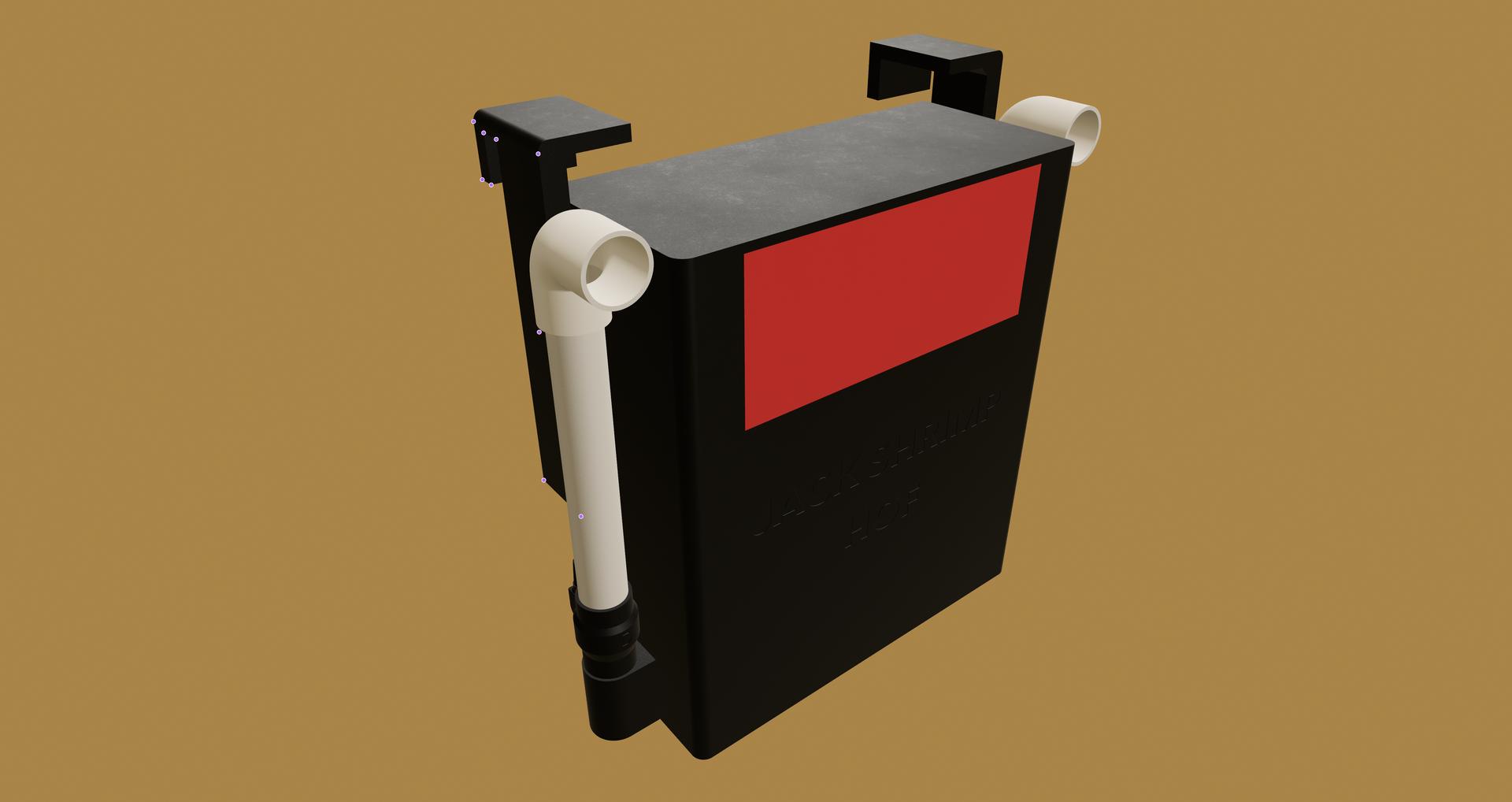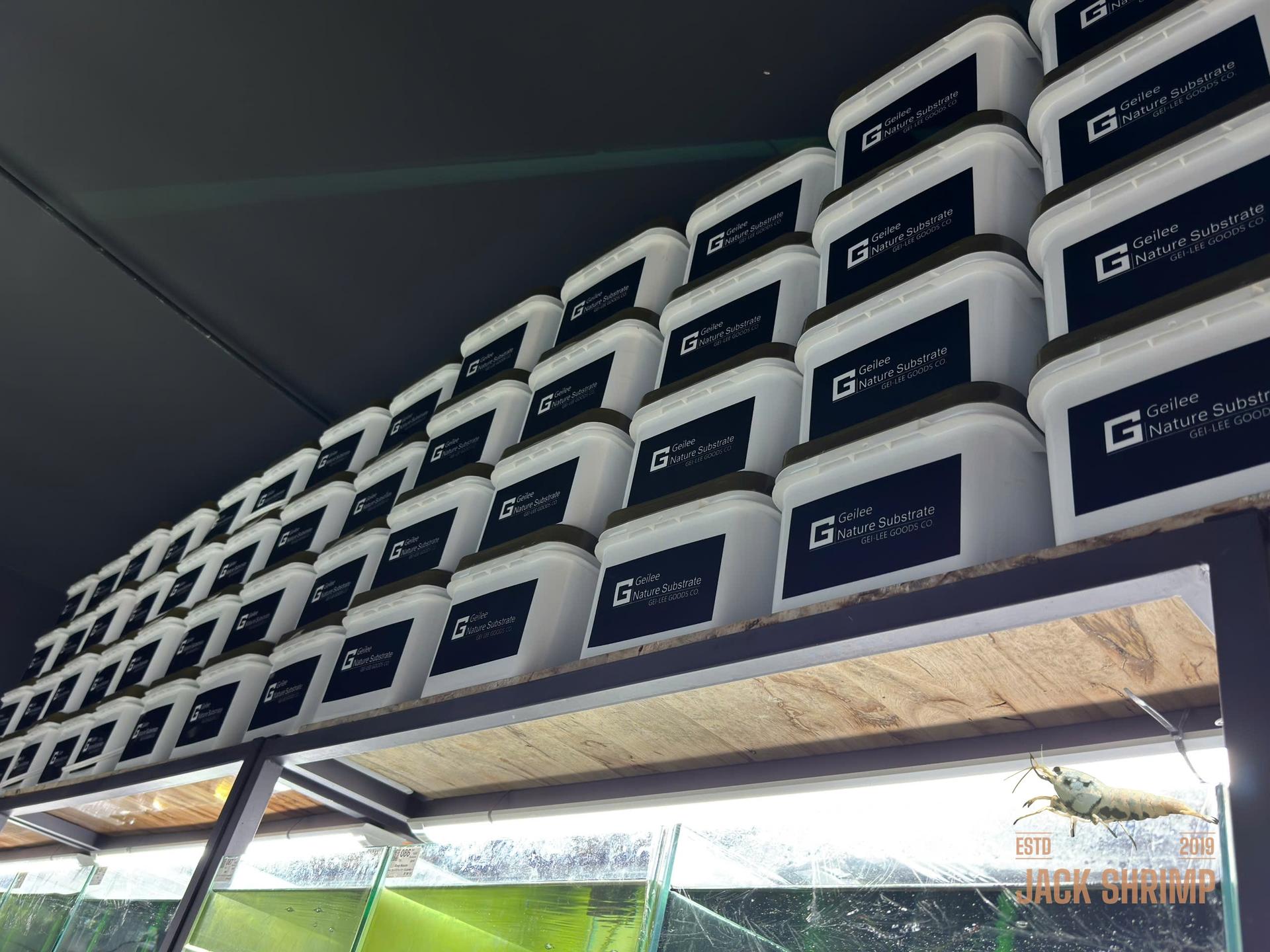
Geilee Soil
Active acid-buffering substrate from the Taiwanese brand Geilee. It is not decoration on the tank floor — it pulls pH down to 5.5–6.5, strips KH out of the water and holds a Caridina tank stable for roughly 12–18 months. This page states what we could verify, and says plainly what we could not.
Soil is not decoration on the bottom of a tank. In a Caridina tank, the soil is life support.
What Geilee is, and why this page is unusually careful
Geilee (給力 / 给力, pronounced roughly "Gei-Lee") is a Taiwanese shrimp-hobby brand trading normally on the international market under Gei-Lee Aqua Goods Co., with a full product line covering substrate, bacteria, foods, UGF boxes and GH conditioner. It is stocked by specialist shrimp retailers in the UK, Singapore, Australia and North America — meaning this is a real brand, not a grey-market import. But you should know one thing before reading further: almost every technical figure attached to this soil comes from someone selling it, and those figures contradict each other. There is no manufacturer datasheet, no independent lab test, no third-party review, and virtually nothing written about it in Vietnamese. So this page is built on a different principle from an ordinary product page: the technical backbone is the chemistry of active substrate in general — thoroughly documented and true of every acid-buffering soil — while anything claimed only by Geilee's sellers is attributed to who said it and where. Where we are unsure, we say so.
What active soil does to your water
Why a KH-0 Caridina tank does not crash
In an ordinary tank, KH is the buffer — carbonates resist pH change. But Caridina need KH 0–1, which by definition leaves the water with almost no buffering capacity of its own. Removing the carbonate buffer is exactly what allows pH to sit at 5.5–6.5, where bee shrimp actually breed. That leaves a dangerous gap: zero KH normally means violent pH swings. The active substrate fills that gap — it performs the stabilising role KH performs in a Neocaridina tank, without carbonates.
This is the band the soil pulls water toward, not a figure printed on a box. Four Geilee dealers in the UK, US and Australia publish four different pH ranges — 5.5–6.5, 5.5–6.5, 5.2–5.8 and 5.4–5.8. We publish the widest and say why: the final number depends on your source water, the ratio of soil to water volume, and the age of the tank. The Australian dealer wrote the one sentence that matters — buffering is relative to soil and water volume.
When the soil dies the tank has no buffer at all — not weaker, zero. That is why exhaustion collapses a colony suddenly rather than gradually. A keeper who sees pH drifting up and responds with bigger water changes is accelerating the failure, because every change delivers a fresh load of Ca/Mg for the soil to strip.
The classic Caridina killer. GH+ raises GH without touching KH — correct for Caridina. The GH/KH+ formulation (2:1) is recommended by its maker for every shrimp EXCEPT Caridina. The reason is blunt: every dose of carbonate is capacity the soil must strip out again. You pay for remineraliser, burn through soil twice as fast, and block the very low pH you bought the soil to reach.
Here we speak in the farm's own voice rather than citing: no source we could reach states this outright. But the mechanism is clear — crushed coral and limestone are a continuous carbonate source working directly against the soil, and unlike a mis-dosed remineraliser you cannot switch them off. Heavy-shelled snails in a KH-0 tank belong in the same caution.
Specifications — and where we left blanks
- Brand
- Geilee (給力 / 给力, "Gei-Lee")
- Brand origin
- Taiwan
- Type
- Active buffering substrate
- For
- Caridina — bee, crystal, Taiwan Bee, Pinto, Fancy Tiger
- Colour
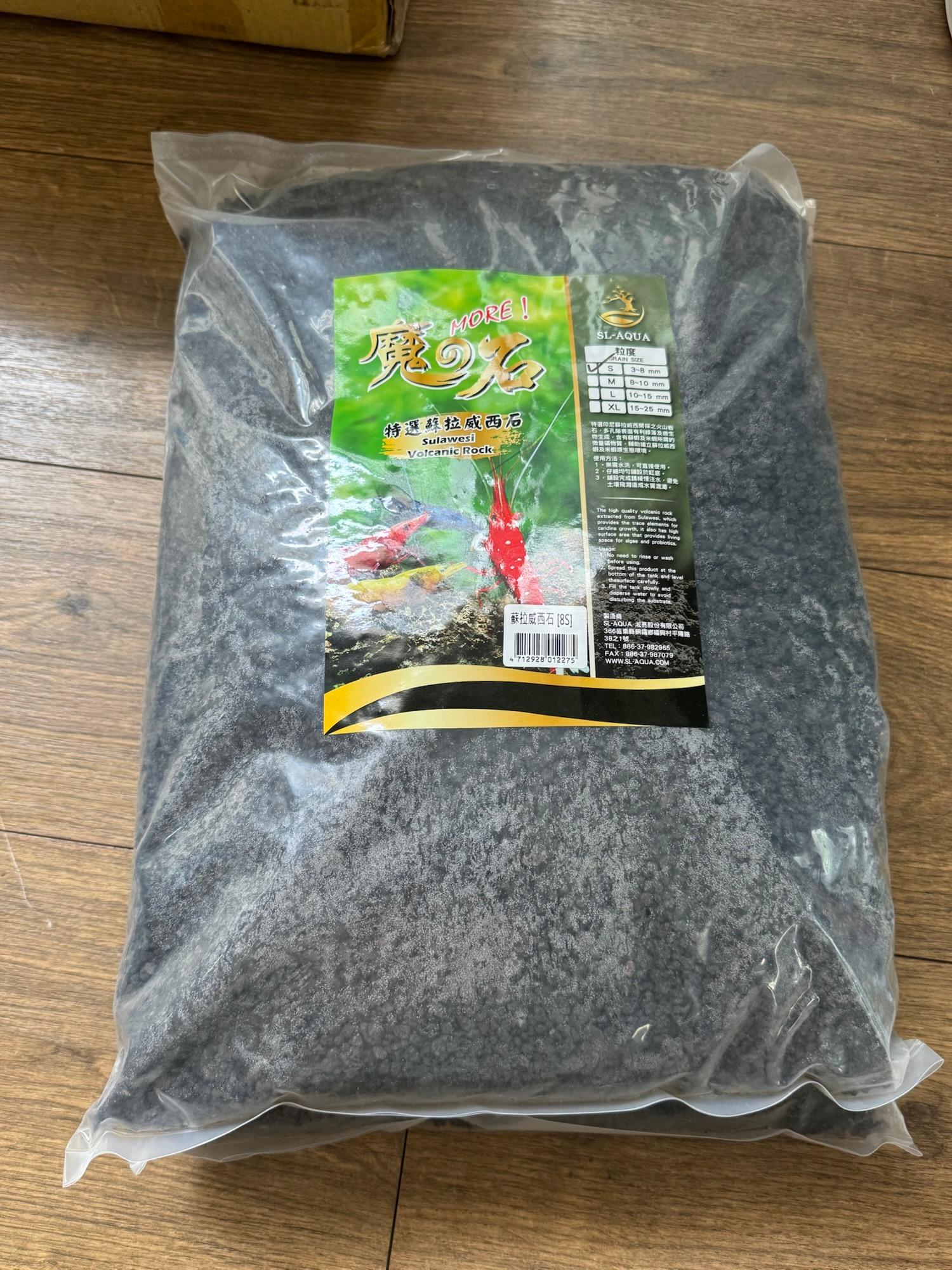
- Black
- Packaging
- 8 litre resealable tub
- Grain size
- Large grade
- Covers
- 2–3 tanks of 60 L, or one 90 L with soil left over
- Buffered pH
- 5.5–6.5
- Dosing
- ≈ 1 L of soil per 30 L of water
- Bed depth
- 3–5cm
- Run the tank empty first
- 4–8weeks
- Expected life (on RO)
- 12–18months
- Rinse before use?
- NO — never rinse
How much to buy
- 20 L tank (30×20×25)
- ≈ 0.7L of soil
- 30 L tank (40×25×30)
- ≈ 1L of soil
- 60 L tank (60×30×35)
- ≈ 2L of soil
- 90 L tank (90×35×40)
- ≈ 3L of soil
- Heavily planted
- 5–7 deepcm
Deeper soil holds more exchange capacity and lasts longer — true. But a very deep bed grows anaerobic pockets. Use 1–2 inches (2.5–5 cm) shrimp-only, 2–3 inches (5–7.5 cm) if planted, for root support. On powder grade: the standard practice is normal grain as the bed with a thin powder cap for looks and shrimplet safety — but compacted powder buffers markedly WORSE, so keep it a thin cap and never the bulk of the bed.
Set-up: six steps, and the most important one is waiting
1 · Lay the soil — do NOT rinse
Pour straight from the tub into the dry tank and level to 3–5 cm. Rinsing active soil destroys it: the water strips nutrients and the mechanical force shatters granules, turning buffering soil into mud. This is the great inversion — every bag of sand and gravel says rinse thoroughly, so keepers do it by reflex.
2 · Fill very gently
Lay a plate or a sheet of plastic on the bed and pour onto that so the stream never scours the soil. Cloudy water in the first few hours is normal; let the filter clear it.
3 · Run the tank EMPTY for 4–8 weeks
Fresh soil leaches ammonia for roughly the first two to four weeks. A full nitrogen cycle takes 6–8 weeks. This is a stage with no shrimp in the tank — not a stage for 'a few to test the water'.
4 · Test until ammonia AND nitrite are zero — and STAY at zero
The correct instruction is not a number of weeks but a test result. Ammonia 0, nitrite 0, and holding there across several tests a few days apart.
5 · Then wait longer for biofilm
After the cycle completes, wait roughly another month with weekly water changes. That time is not for the filter — it is for the biofilm and microfauna that shrimplets actually eat.
6 · Add shrimp — and Caridina are never the first inhabitants
Caridina are markedly less forgiving than Neocaridina. If you want to test the tank, test it with a few cheap Neocaridina or snails, not with the bee shrimp you just paid for.
Two international dealers advertise Geilee as leaching no ammonia and safe to add directly to an established tank. A third writes 'minimal to no ammonia leaching' and on the same page states a typical cycle time of 3–5 weeks. A soil that genuinely released no ammonia would not need a 3–5 week cycle. We do not print that claim here. If a customer believes it, adds shrimp on day one, and the soil releases even 0.5 ppm, the colony is gone — and the loss lands on the customer, not the copywriter. Just test. Testing is cheaper than replacing a colony.
How long it lasts, and what shortens it
- On RO + GH+ remineraliser
- 12–18months
- Soft tap water
- 8–12months
- Hard tap water (high KH)
- Shorter still
- Frequent / large water changes
- Shortens life
- Deeper bed
- Extends life
- Can spent soil be recharged?
- NO. Replacement only.
Every degree of KH in your source water is soil capacity spent on arrival. The harder the water, the sooner the soil dies. Vietnamese municipal water is commonly hard and chlorinated — this is the number one reason a customer's soil 'fails early'. An RO unit pays for itself in the tubs of soil you do NOT have to buy again. That is an economic argument, not a luxury one.
A hypothesis circulates on forums that accumulated mulm will 'revitalise' soil over time. It is untested speculation and it runs against the ion-exchange mechanism: mulm does not regenerate saturated cation-exchange sites. Old soil still has value as an inert base layer and as a bacterial seed — but none as a buffer.
Six signs the soil is finished
The two mistakes that kill soil fastest
Never rinse active soil. Rinsing strips nutrients and the water pressure shatters the granules. The trap is that every inert sand and gravel MUST be rinsed thoroughly — so the keeper's existing reflex is exactly what kills the soil in its first ten minutes.
Surface-clean only. Driving a siphon into the bed does two kinds of harm at once: it grinds the granules apart, and it destroys the bacterial colony living inside their pores. Constantly uprooting and replanting does the same damage.
Straight talk: we sell it, and here is what we do not know
We sell this soil, and we will still tell you what we do NOT know about it. Geilee is a real Taiwanese brand trading normally through specialist shrimp dealers in the UK, Singapore, Australia and North America, with a full line covering substrate, bacteria, foods and remineraliser. But almost every technical number attached to this soil comes from someone selling it. There is no manufacturer datasheet, no independent lab test and no third-party review. And the dealers' numbers CONTRADICT each other on exactly the two things that matter most: buffered pH, and whether it leaches ammonia.
No manufacturer name — no source states which factory makes it, and we will not guess. No 'made in Japan' — that comes from a single Facebook post and contradicts the Taiwanese corporate identity. No 'better than ADA Amazonia' or 'the best Caridina soil available' — those are sellers' words, based on under a year of their own use, with no independent comparison in existence. No grain size in mm — nobody publishes it; we will measure our own. No TDS released or KH stripped — those numbers do not exist anywhere.
We teach customers a free way to check the soil is alive: measure TDS in your mixing bucket, then in the tank. Working soil always pulls the in-tank number lower, and that gap is its remaining capacity. Gap closed and pH past 7 means it is spent. To be straight with you: the phenomenon is real and mechanistically sound, but we could NOT find any source documenting it as a named test. This is the farm's own rule of thumb — use it alongside logging pH and GH, not instead of.
Which tanks this soil is for
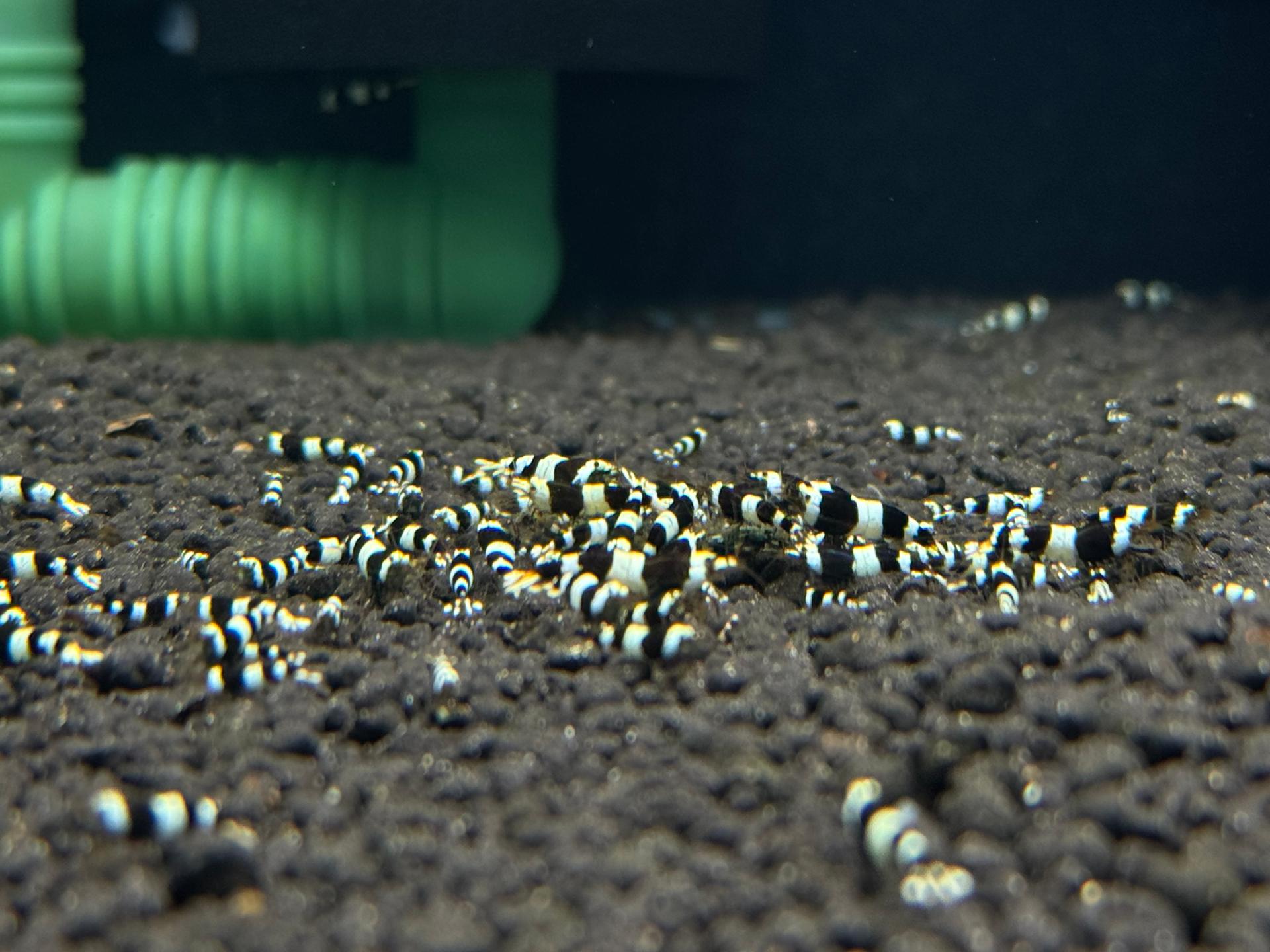
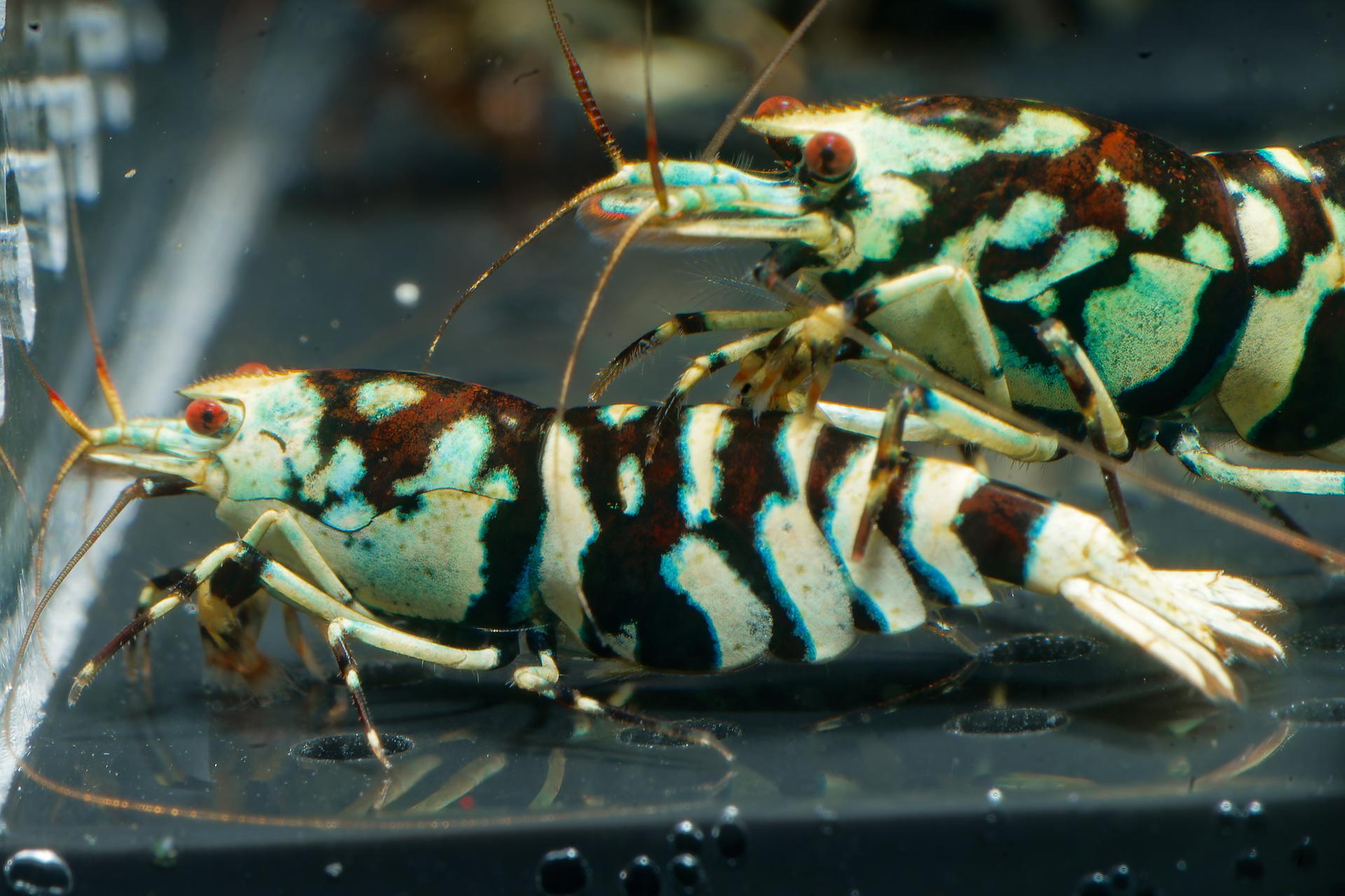
Geilee Soil is for Caridina only — bee, crystal, Taiwan Bee, Pinto, Fancy Tiger. If you keep Neocaridina you do NOT need this soil: they thrive at pH 6.5–8.0 and a far cheaper inert substrate is entirely sufficient. Below are two of our Caridina lines running on acid-buffering soil, together with the remineraliser and bacteria that belong with it. The single most important note when buying remineraliser: choose GH+, never GH/KH+.
Not sure how many litres you need?
Send us your tank dimensions and what water you run (RO or tap) and we will work out the volume of soil, the bed depth and a cycling schedule for that specific tank. Free advice, no purchase required.
Read the Caridina tank set-up guide